We’re not getting smarter with AI. We’re just getting better at hoarding prompts and calling it “innovation.” The real danger isn’t AI replacing us. It’s us quietly forgetting how to think for ourselves. Integrating any AI and creativity requires your mind first, not just your filled-up folders.
It was approaching 3:00 AM. I was in our office in Casablanca. A visual identity presentation for a high-profile real estate client was due at 9:00 AM. I sat in front of a massive Notion folder I called “Magic Commands.” It contained hundreds of ready-to-use texts for generating ideas. I copied complex command after complex command. The results were soulless. Just faint designs that reflected zero authenticity.
I was wasting time tweaking saved prompts. I ignored thinking about the true essence of the project. In a moment of desperation, I closed all those organized folders. I opened a blank document and simply wrote exactly what I wanted. I described how the client should feel when seeing the logo. I stepped away from the ready-made command templates that had completely restricted my thinking.
I took that spontaneous paragraph and put it into ChatGPT 4 to analyze angles. Then I transferred it to Midjourney v6 to imagine it hundreds of times. In just 45 minutes, I got three strong visual concepts. The client approved one enthusiastically the next morning. This situation pushed me to write this article. For every creative who believes that hoarding prompts makes them more innovative.
- Why do we collect commands instead of thinking?
- File chaos: how saved commands create mental noise
- Erosion of thinking: when commands take over creativity
- Prompt engineering: a phantom skill in the world of AI and creativity
- From partner to substitute: how AI is misused
- Thinking first: the secret to making AI an effective partner
- The right balance: combining commands with creative thinking
- What I discovered after 40 visual identity projects with Midjourney v6
- The bottom line: reclaim the lead on your ideas
Why do we collect commands instead of thinking?

The blank page forces us to think deeply. It pushes us to confront what we really want and what good work means.
This feeling is annoying and reveals our weakness at the start. Therefore, saved commands intervene as a comfortable safety net.
1.1 Avoiding the blank page: how commands become a safe haven
Someone else has already structured the idea. Someone else has thought about the details on your behalf. This seems much easier than starting from scratch.
But every time we avoid the blank page, we lose a golden opportunity. We lose the chance to build our creative confidence. We become faster at avoiding annoyance rather than dealing with it.
Over time, we believe we need these commands just to start. This is not innovation at all. It is dependency disguised as productivity.
1.2 The productivity illusion: why feeling busy doesn’t mean progress
In a mobile app design project, I gathered 50 commands to generate user interfaces. I thought I was preparing well for the project. But I spent two hours browsing them without drawing a single useful screen.
Saving commands gives us a false sense of responsibility. You imagine you are building a library of genius for your future. But when you return to it, it rarely helps you finish the work.
It is just text written for other people solving different problems. This illusion of preparation leads us directly to the next problem in managing our files.
File chaos: how saved commands create mental noise
The apparent order of those folders hides a massive mess in the mind. You gather information and think you are acquiring real skill.
2.1 A useless library: why saved collections become a burden
You scroll the screen and keep scrolling endlessly. Instead of clarity, you feel more stuck than before. Information gathering does not magically turn into deep understanding.
Storage never equals skill acquisition. You can have twenty folders full of complex commands. Yet you sit there thinking: what do I really want to build?
In one e-commerce project, I faced this problem precisely. The client wanted product descriptions in a local Moroccan style. I used saved commands written for foreign markets, and the result was a disaster. I had to delete everything and start over.
2.2 Searching for an oasis in a text desert
Searching for the right command consumes huge creative energy. You try to adapt your idea to fit the ready-made command. This reflects and distorts the creative process exactly.
Whether you work individually or within a team, resource management differs. I discussed this challenge in an article comparing freelancing versus agency work and how to organize time. The accumulation of these texts creates noise that prevents you from hearing your own voice.
This constant noise slowly begins to change the way our brains work.
Erosion of thinking: when commands take over creativity
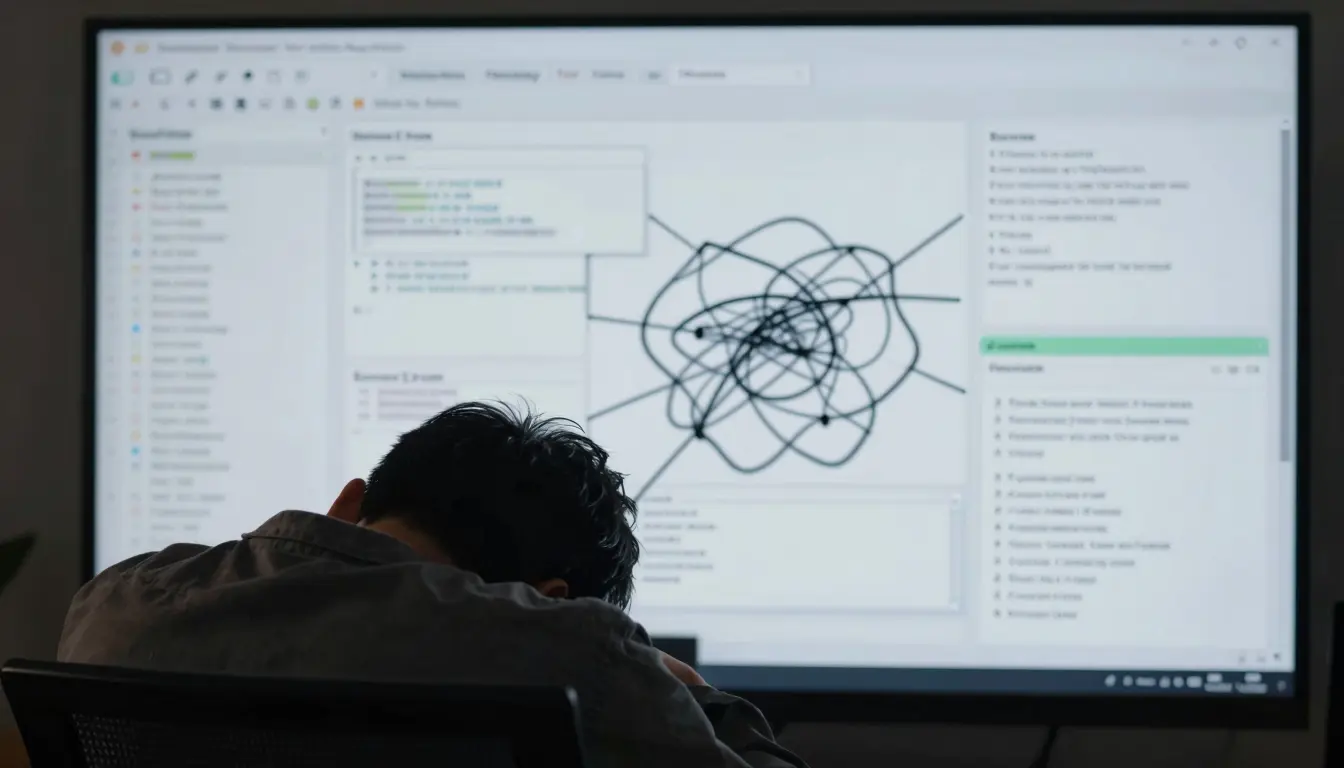
This problem sneaks up on creatives without them noticing. At first, commands are just shortcuts to speed up work. Then they become the default starting point for every new project.
3.1 Losing intuition: how you turn from a creator into a reviewer
You stop wrestling with ideas yourself. You inherit someone else’s thinking framework, their language, and their assumptions. You stop shaping ideas and settle for managing outputs only.
Then your professional intuition fades and your artistic taste weakens. “Looks good” replaces “This work is genius.”
This happened to me in a marketing campaign for a startup. I relied on ready-made commands to generate ad copy. The result was a bland campaign that achieved 40% fewer clicks. I discovered I was reviewing machine texts instead of creating them.
3.2 The linguistic legacy: why your language becomes limited by others’ texts
Using others’ commands imposes their specific vocabulary on you. You lose your linguistic signature and become a repeated copy. You don’t realize it because technically you are still producing.
But in reality, you are no longer driving the steering wheel. This surrender to the machine’s language leads us to discuss a widespread lie today.
Prompt engineering: a phantom skill in the world of AI and creativity
There is a lot of noise claiming that prompt engineering is the new superpower. The word sounds exclusive and suggests empowerment and control. But directing the machine is just describing instructions clearly.
4.1 Description versus creativity: the fundamental difference
Commanding is not a completely new skill, nor is it magic. The real skill was and still is mental clarity. If you cannot explain your idea to a human, the machine will not save you.
You will only get confusion arranged beautifully. This confusion between description and deep thinking is a common trap. This is exactly what an article on Why saving prompts won’t make you creative details accurately.
Innovation requires vision, while description only requires correct language. In designing a website for a medical clinic, I needed images that reflected reassurance. Complex commands failed, while thinking about the patient’s feeling succeeded.
4.2 The real questions: what to ask before writing any command
What is the primary goal of this work? Who are we directing this message to, and what matters to them? How does failure look in this specific project?
What will we feel when we reach the great result? The answers to these questions are what make the real difference.
Without them, your technical assistant becomes a substitute that makes decisions for you.
From partner to substitute: how AI is misused
Technology should be a powerful tool in your hand. You set the plan and determine the direction, and the machine helps you execute. But relying on commands reflects this equation exactly backwards.
5.1 The supervisor role: why reviewing is not enough
If ready-made prompts are doing the thinking first, the machine is deciding. You settle for reviewing, editing, approving, and repeating. This pattern looks effective and fast in the short term.
But it turns you into a supervisor rather than a true content maker. Supervisory roles are the easiest to replace with technology later.
At the TwiceBox agency, I noticed this trend among some junior designers. They would generate images and then pick the best one without a prior vision. The result was similar designs lacking the client’s unique identity.
5.2 The future danger: how we lose control of creativity
The machine isn’t being harsh or trying to steal our jobs on purpose. We are voluntarily giving up the most important part of our work. We trade critical thinking for the illusion of production speed.
Then we become just tools to run other tools. We must use these tools responsibly and ethically, respecting intellectual property rights. To avoid this fate, we must reorder our workflow steps clearly.
Thinking first: the secret to making AI an effective partner
There is a simple shift in methodology that flips the balance completely. Your thinking must precede any interaction with the screen. This returns technology to its natural size as a helper tool.
6.1 Simple phrasing: how to write your ideas in plain language
Before using generation tools, take a moment for calm thinking. Write in simple language exactly what you are trying to achieve. Don’t worry about complex structure or fancy phrasing.
Be honest and direct in describing your goal and your audience. In an educational platform development project, I applied this rule. Instead of writing complex code for ChatGPT.
I explained the user interaction logic with the lessons in simple steps. I got a clean code structure that saved me 3 hours.
6.2 Smart collaboration: turning ideas into enhanced outputs
After writing your idea clearly, bring the machine into the equation. Suddenly, you will feel like you are working with a collaborator, not a crutch you rely on. Outputs will become more logical and aligned with your vision.
You will find that edits have become easier and more precise. You will know immediately what works and what should be discarded. Interestingly, you will need fewer saved commands.
This shift leads us to how to find the right balance in our work.
The right balance: combining commands with creative thinking
Don’t leave commands completely, but don’t surrender to them. The machine isn’t evil, but forgetting our role in thinking is the danger. Balance is the key to sustainability in this field.
7.1 When to use the command and when to rely on yourself
Keep commands if they speed up your routine, boring tasks. Use them to format data or summarize long texts. But don’t let them steal the joy of making critical decisions.
Observing, questioning, and imagining are purely human tasks. In programming website interfaces, I use commands to generate repetitive code. But I write the core interaction logic myself to ensure performance quality.
7.2 Tool evaluation: how to choose commands that truly serve you
Innovation still lives in your mind first. Everything else is just a tool following your directions. Choose commands that serve your vision and don’t impose a path on you.
Get rid of the stacked folders you haven’t used in months. Keep only what proves its effectiveness in improving your work quality.
This balance led me to discover a practical technology that changed my method completely.
What I discovered after 40 visual identity projects with Midjourney v6
We often waste long hours trying to describe a precise visual style. We keep adding complex words to generation programs to reach the result. But we are always surprised by that glossy, plastic, and repetitive appearance.
Here we discover that interacting with algorithms clashes with a language barrier. Words sometimes fail to convey the image’s feeling accurately. In one visual identity project for a local brand, I changed my approach.
I abandoned stacking descriptive style words in Midjourney v6. Instead, I relied on the Style Reference feature to convey the feeling. The first step is copying a link to an image that embodies the desired visual spirit.
Then writing a simplified idea and adding the --sref parameter followed by the link. Finally, I added the --sw parameter with a value of 800 to determine the influence strength. This number is capable of hiding the AI’s usual style completely.
Previously, I would write 50 words and waste 120 minutes with no result. Now, I use a simplified idea with an image link in 5 minutes. This raised work efficiency by 95% noticeably.
This method saves us when designing identities with a North African touch. Algorithms translate words into stereotypical oriental templates. While the reference image conveys the colors of Zellige and the texture with extreme precision.
Just avoid images that contain text or clear faces. The algorithm will try to combine them as distorted elements in the final result.
The bottom line: reclaim the lead on your ideas
Tools exist to shorten the distance between idea and execution, not to replace your vision. Real innovation stems from clarity of thinking, not the complexity of commands. Get rid of half of the command folders you never use today.
What is the tool that you feel has started to control your creative decisions recently?
Discover more from أشكوش ديجيتال
Subscribe to get the latest posts sent to your email.
![71% من وكلاء الذكاء الاصطناعي مجرد روبوتات محادثة [دراسة]](https://hcouchd.com/wp-content/uploads/2026/09/file_000000008f4081f6b4bb9314f653051e-1024x576.webp)