
You open a website.
You click a button.
It responds instantly.
No reload. No flicker. No waiting.
Now pause.
Another website. Same action.
You click… wait… the whole page reloads… your scroll resets… frustration kicks in.
Ever wondered what creates that difference?
Let’s walk through it. Not like a lesson, but like a journey you’ve probably already lived. You just never noticed the underlying technology.
- 1 Where Did React Come From? A Quick Trip Through History
- 2 What Is React? Understanding the Core Concept
- 3 Why Do Developers Choose React? Overcoming Code Chaos
- 4 Why Is It Called “React”? Understanding Automatic Responsiveness
- 5 What Is a Component? The Cornerstone of React
- 6 Why Is React a Library, Not a Framework? Understanding Flexibility and Control
- 7 Why Do We Need Node.js When Working with React? Behind the Scenes
- 8 Why Does React Feel Different? Shifting to a Component Mindset
- 9 The Infinite Update Trap: A Hard Lesson From My Projects
- 10 Conclusion
Where Did React Come From? A Quick Trip Through History

Let’s rewind the clock a bit.
Web applications began growing more complex.
Developers faced an increasingly difficult problem.
Synchronizing the user interface with changing data became chaotic.
Challenges of Complex User Interfaces
At Facebook, engineers encountered this exact issue.
The platform was growing incredibly fast.
Updating the interface efficiently became a daily challenge.
Manually editing page elements was slow.
Every new message required a complex update.
Jordan Walke’s Idea: Automatic Updates
This is where an engineer named Jordan Walke emerged.
He proposed a simple, yet revolutionary idea.
What if the interface updated automatically with the data?
He built a prototype focusing on smart components.
He abandoned the tedious, manual updates.
This brilliant concept became the core of the tool.
Announcing React to the World
In 2013, Facebook announced the library.
It became an open-source project for everyone.
Initially, many doubted its usefulness.
Mixing HTML with JavaScript seemed strange.
But developers soon recognized its power.
Complex interfaces became much simpler.
This historical development leads us to an obvious question now.
What Is React? Understanding the Core Concept
Imagine you want to rearrange your room.
You move just one chair.
Suddenly, all the furniture in the room rearranges.
This sounds absurd and illogical.
But that’s how traditional web applications often work.
The Room Rearrangement Analogy
Now imagine a different, smarter scenario.
You move the chair. Only that chair moves.
The rest of the room remains stable.
This technology does exactly that.
It updates only the changed part.
It doesn’t rebuild the entire page from scratch.
Focusing on Precise Updates
The focus here is on extreme precision.
Performance improves noticeably and very quickly.
Precise updates significantly conserve browser resources.
When you grasp this vast performance difference, you start questioning old methods. This question opens the door to deeper understanding of daily problems.
Why Do Developers Choose React? Overcoming Code Chaos
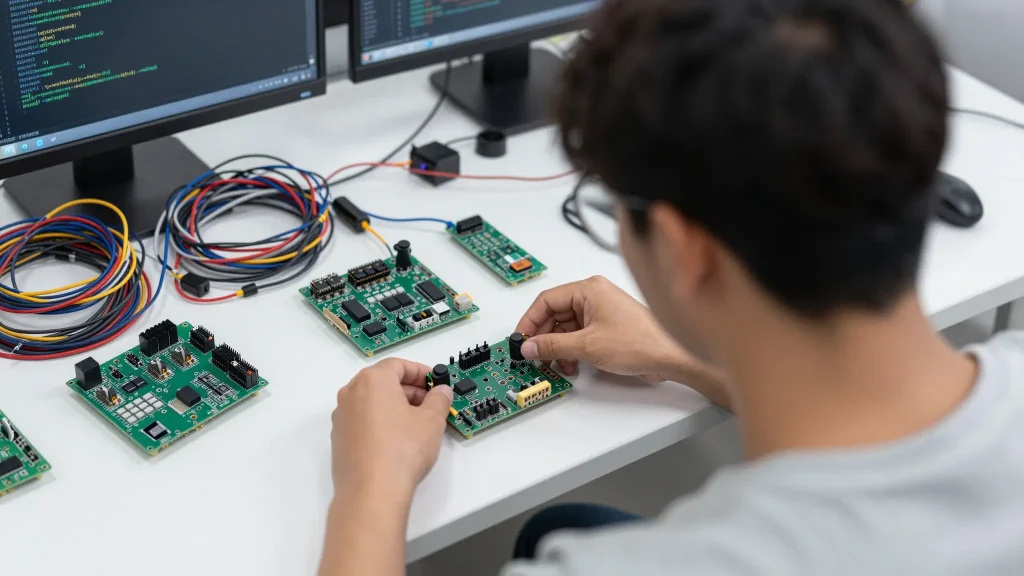
You’re working on a project that seems small and straightforward.
You add a button here, a form there, quite simply.
Everything seems to be going well.
Then, suddenly, one modification breaks three parts.
From a Large System to Small Pieces
Fixing one error generates two new ones.
The code becomes an intertwined mass, hard to understand.
This is where breaking down the large system comes in.
We transform the application into small, independent pieces.
Each piece performs its function without interference.
This isolation prevents annoying code conflicts.
Reducing Errors and Increasing Predictability
Developers don’t switch just to follow trends.
They seek to reduce daily chaos.
This work structure makes the code predictable.
The error rate drops significantly.
You regain confidence in your code.
This explains why everyone confidently moves to React. But how does the tool know exactly what to update?
Why Is It Called “React”? Understanding Automatic Responsiveness
You order food via an app on your phone.
You change the quantity from one to two.
You notice an immediate screen response.
The price updates, and the cart total changes automatically.
Instant Updates Without Intervention
You never refreshed the page.
You didn’t press any confirmation button.
The change happened smoothly and instantly.
When data changes, the library responds immediately.
It updates the interface without manual instructions.
There’s no need to meticulously manage screen elements.
The Difference Between SPA and MPA
Here we understand the difference between technologies.
In multi-page applications (MPAs), you move to a new room.
You leave the page and load another from the server.
In single-page applications (SPAs), you stay put.
Content updates before you without interruption.
The experience is faster because it doesn’t reload. To build this experience, we need a better structure based on fragmentation.
What Is a Component? The Cornerstone of React

Let’s assume you’re building a massive digital platform.
Instead of building everything at once, you divide it.
You break the platform into small, defined parts.
One part for the menu, another for user data.
Independent Building Blocks
Each part functions as an independent building block.
You can develop and test it in isolation.
This is the concept of a Component.
It’s a small, entirely independent piece of code.
It acts like a JavaScript function returning visual code.
// A simple, independent button component usable anywhere
function CustomButton() {
  return (
    <button className="btn">
      Click Here
    </button>
  );
}
Reusability and Efficiency
Imagine copying this piece and using it anywhere.
There’s no need to rewrite the code again.
This saves time and reduces annoying repetition.
In one project, I designed a single purchase button.
I used it in fifty different places on the site.
Changing the button’s color requires modification in just one file.
Building Integrated Systems
You are no longer building static pages.
You are building an integrated system of pieces.
These pieces interact to form a complex application.
When you think this systematically and organized way, returning to old methods becomes impossible. But why didn’t Facebook make it a comprehensive framework?
Why Is React a Library, Not a Framework? Understanding Flexibility and Control
Let’s assume you join a company with strict rules.
The folder structure is predefined and unchangeable.
Tools are imposed on you from day one.
The way you write code follows rigid laws.
The Difference Between a Library and a Framework
You feel like you’re following a map drawn by someone else.
This is precisely the concept of a framework.
It provides a ready-made structure but restricts you.
In contrast, a library is like an open workshop.
You choose your tools and arrange your workspace.
Freedom of Choice and Tools
This tool grants you the freedom to choose technologies.
You can integrate it with any other package.
It’s like how you flexibly choose WordPress themes.
You design the experience that suits your project.
There are no restrictions preventing innovation.
Control Over Application Architecture
You have complete control over the application’s architecture.
It focuses solely on the user interface.
It doesn’t interfere with routing or servers.
This strong freedom comes with responsibility.
It requires you to make sound architectural decisions. This leads us to understanding the runtime environment we need.
Why Do We Need Node.js When Working with React? Behind the Scenes
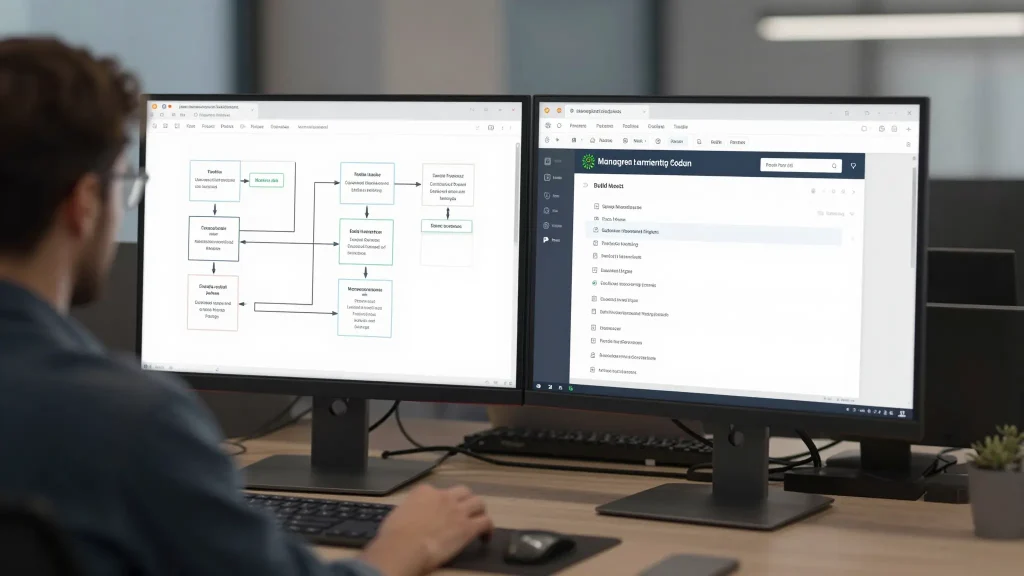
Imagine preparing for a stage play.
The audience sees the actors on stage.
But much happens behind the scenes.
Arranging lighting, adjusting sound, preparing sets.
Package Management and Development Tools
The Node.js environment plays the backstage role here.
The library runs within the end-user’s browser.
But we need a robust environment for development management.
It helps us install packages and utility libraries.
Without it, you’d manage all dependencies manually.
This would waste hours of your valuable time.
Development Servers and Compilation
The environment runs fast local development servers.
It converts modern code into a format the browser understands.
It uses advanced tools to compress and optimize files.
All this happens silently in the background.
You get optimal and very fast performance.
This integration makes the entire experience harmonious and smooth.
Why Does React Feel Different? Shifting to a Component Mindset
At some point, your thinking completely changes.
You stop asking yourself, “How do I update the page?”
You start thinking about the data that changed.
This shift seems simple but is radical.
From Page Updates to Data Management
Once data changes, the library handles the rest.
You manage the application’s state.
The interface is merely a reflection of this programmatic state.
This allows you to focus on business logic.
Instead of wasting time moving screen elements.
Feeling Confident in Your Code
You start feeling great confidence in your code.
You know modifications won’t break the system.
You can scale the project regardless of its size.
This feeling of control is what distinguishes it.
You move from fighting annoying code.
To shaping dynamic digital experiences.
The Infinite Update Trap: A Hard Lesson From My Projects
One night working at TwiceBox, I faced a disaster.
I was building a dashboard displaying live statistics.
I used an update function to fetch data from the server.
Suddenly, my browser became completely unresponsive.
My computer started making a strange noise.
I discovered the component was re-rendering wildly.
It was requesting data fifty times per second.
The error was forgetting the dependency array in useEffect.
This simple mistake cost me hours of frustration.
I learned that freedom requires a deep understanding of tools.
Always specify when a component should update.
Use developer tools to continuously monitor performance.
This saves you from application crashes in front of the client.
Conclusion
Adopting this mindset takes time.
But once you understand the principle of independent components, you’ll never go back to writing interfaces the old way. Start today by building a simple component and trying it yourself. What tool are you currently using to build interfaces for your projects?
Discover more from أشكوش ديجيتال
Subscribe to get the latest posts sent to your email.