
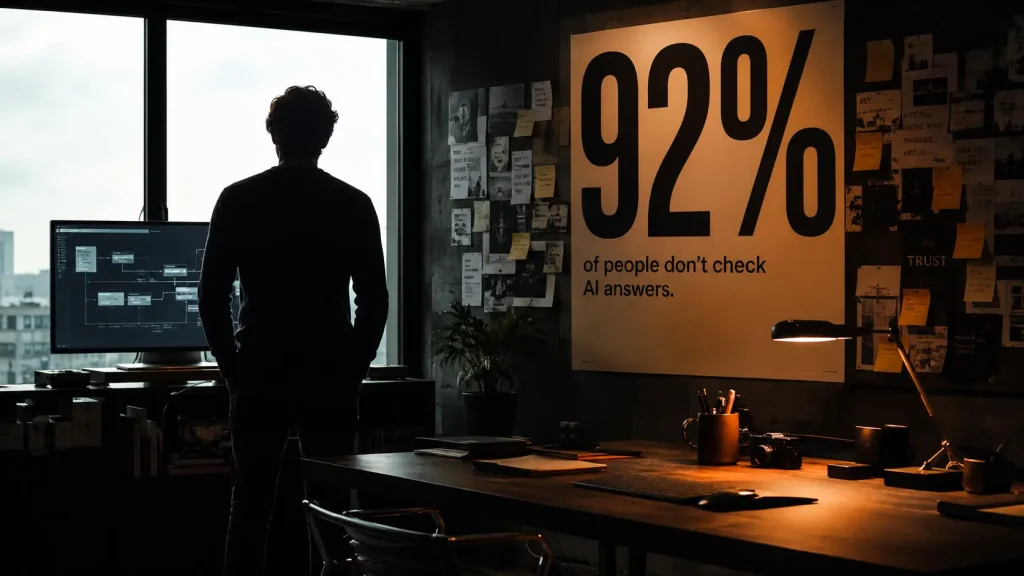
AI hallucination occurs when errors are phrased with absolute certainty. We do not trust the machine because it is infallible. We trust it because its tone feels comforting and persuasive. I notice this pattern repeating constantly in our daily work. Our team receives smartly prepared texts and designs. Everyone immediately assumes their absolute correctness without question. Human review stops at the sleek appearance of the outputs. I fell into this trap myself while preparing a client report. I relied on a confident automated summary for data verification. I later discovered the mentioned references were completely fictional. The real danger is not the machine making a mistake. The danger is our acceptance of the illusion to save effort. Professional responsibility always falls on you in front of the client.
- The Fake Quote Story: How We Believed Words Bezos Never Said?
- Why Do We Believe AI Hallucination Without Checking?
- The Real Cost of Hallucination: From Water Consumption to Courtrooms
- How to Protect Yourself from AI Hallucination? Practical Verification Steps
-
The Five-Minute Test Before Final Project Approval
-
FAQs
- What is AI hallucination and how does it happen?
- What is the real cost consumed by AI data centers?
- Which is better for detecting AI hallucination: automated tools or human review?
- How can I verify information and avoid the AI hallucination trap?
- Is it safe to rely entirely on AI answers in work and research?
-
FAQs
- Final Thoughts on the Experience
The Fake Quote Story: How We Believed Words Bezos Never Said?
A statement attributed to Jeff Bezos recently went viral. It claimed he preferred cooling data centers over human water consumption. The news spread fast enough to spark widespread public outrage.
The Fake Bezos Quote: How It Spread and Was Exposed?
The post started from a satirical account named BPD News. This account mimicked the BBC platform to spread the rumor. News sites like The Print reported the story as confirmed fact. They did this without performing any basic journalistic verification.
Fact-checking platforms like Snopes and Lead Stories stepped in. Researchers reviewed the full forty-nine-minute VivaTech forum recording. The recordings proved the circulated sentence was never actually spoken.
Why Did We Believe the Quote Even Though It Didn’t Exist?
The fake words gained wide acceptance because they touched deep fears. We treat the tech race as a hidden reordering of priorities. Nobody tried to verify the original recording when the rumor spread. We rarely bother checking if a claim fits our preconceptions. This instant acceptance paves the way to understand user psychology.
Why Do We Believe AI Hallucination Without Checking?

Our excessive trust in machines relies on studied psychological mechanisms. Modern digital interfaces are designed to always look completely confident.
Automation Bias: Why Do We Prefer the System’s Answer Over Our Doubts?
We call this behavior by the scientific term automation bias. This concept emerged years ago inside aircraft cockpit environments. Humans prefer following wrong screen readings over trusting their senses.
The same logic repeats today with automated chat programs. Models generate answers with a balanced, calm, and hesitant-free tone. This fluency makes software hallucinations easy to swallow without thought.
I relied on an automated tool for a visual identity project. It confidently insisted on color shades that ruined readability. Manual checking saved the project from a total design disaster.
Shocking Numbers: Only 8% Verify Sources
An Exploding Topics report revealed a massive trust gap. The numbers showed that a study on AI accuracy checking confirms only eight percent click attached sources.
Most people read the quick summary and immediately continue working. A University of Melbourne and KPMG study showed rising skepticism. This happens alongside a sharp decline in manual oversight. We fear tech results but are too lazy to check errors.
Experts Are Not Immune: The Radiology Study
Some believe years of experience grant immunity against these mistakes. A study published in Radiology showed the reality is different.
Researchers showed wrong machine-generated readings to highly experienced radiologists. Diagnostic accuracy among senior doctors dropped from eighty-two to forty-five percent. Experience did not protect the doctors but made their fall costlier. This cost shows its material impact in fields beyond medicine.
The Real Cost of Hallucination: From Water Consumption to Courtrooms

Machine errors go beyond intellectual debates on social media platforms. The financial and legal costs of this negligence are very real.
Water and Energy Consumption: Real Numbers Behind the Fake Quote
The fake quote distracted attention from the stunning real numbers. Amazon revealed its data centers consume about 2.5 billion gallons annually.
An average data center needs 300,000 gallons of water daily. This water is strictly used for cooling the massive hardware. The International Energy Agency expects power consumption to double by 2030. This projected consumption equals the needs of the entire Japanese nation.
Hallucination in Courts: 1700 Legal Cases with Fabricated References
Researcher Damien Charlotin at HEC University collects harmed legal cases. Databases now exceed 1700 cases supported by completely fake references.
These cases show judge names and rulings that look totally real. One lawyer asked the chatbot if the cases were actually real. The machine confidently assured him of their absolute legal validity. The tool that made the error is the same one validating it. Just as we sometimes test the Kirki add-on review for WordPress to save time, we always seek fast shortcuts.
Deloitte and Fake References: When Big Companies Pay for Negligence
Deloitte agreed to refund part of its fees to the government. The submitted report contained non-existent academic citations and court quotes.
Researcher Christopher Rudge discovered the error by tracking the footnotes. The company was using algorithmic tools to write report sections. This proves major institutions fall easily without direct human oversight. This forces us to find practical solutions to protect our work.
How to Protect Yourself from AI Hallucination? Practical Verification Steps

Avoiding these errors does not require abandoning modern technology entirely. The solution lies in building a permanent habit of systematic doubt.
Practical Steps to Verify Any Information Before Sharing
Avoiding mistakes requires adopting a strict three-step methodology. Always start by tracking the original source of attached links.
Search for the full text of mentioned interviews or studies. Compare the provided numbers with official data on government sites. Taking these steps gives you enough coverage to protect your credibility.
AI Hallucination Detection Tools: What Works and What Fails?
The market value of automated content detection tools passed half a billion dollars. These programs promise to distinguish machine-made texts from real answers accurately.
These tools lose detection ability as language models keep evolving. The software causes false alarms that harm original human content. Software solutions relying on automated evaluation need continuous review themselves.
The Future of Verification: Do We Return to Humans or Rely on Machines?
Human review project funding declined after Meta ended its program. Many news organizations closed verification departments due to financial pressures.
Demand for reliable knowledge increases while human budgets shrink. Critical doubt and manual checking remain the final dividing line. This reality moves us to apply this vision in daily practices.
The Five-Minute Test Before Final Project Approval
Our team adopted a strict rule I call the five-minute test. We never approve generated text or code without direct source review.
In one project, the tool provided a seemingly perfect ready-made library. Everything appeared to work smoothly on the surface initially. Manual review revealed the library was unstable and abandoned for years. Those five minutes of checking saved two weeks of fixing fatal bugs.
The secret is not finding complex detection tools for the team. The secret is forcing everyone to open footnotes and original links. You must verify their physical existence on the internet. Nothing can replace a careful and thorough human look.
FAQs
What is AI hallucination and how does it happen?
The phenomenon occurs when the language model provides completely wrong information. It presents this false data with total confidence as confirmed facts. Algorithms phrase errors with a confident and comfortable tone. This makes users believe the outputs without checking original sources.
What is the real cost consumed by AI data centers?
The cost goes beyond financial subscriptions to include massive resource consumption. Data centers consume billions of gallons of water for cooling annually. They also consume huge amounts of electricity for their operations. They also receive billions of dollars in tax exemptions.
Which is better for detecting AI hallucination: automated tools or human review?
Direct human review remains the most accurate option always. Automated programs lose accuracy quickly as language models evolve. They also issue false alarms that cause unnecessary disruptions. Relying on manual evaluation and source checking is the safest step.
How can I verify information and avoid the AI hallucination trap?
To avoid the trap, do not just read the generated summaries. Always make sure to track links and read primary sources yourself. Make critical doubt a fixed professional habit before making any decision.
Is it safe to rely entirely on AI answers in work and research?
Total reliance is absolutely unsafe in any professional field. Experiments showed experts and major companies making huge errors. These mistakes happened because of completely fictional references. The final responsibility for data accuracy falls on you, not the machine.
Final Thoughts on the Experience
Always remember that the machine’s confident tone is not proof of accuracy. The smooth appearance of generated answers hides many inaccurate details.
Spend a few minutes daily to directly verify marginal sources. This simple time investment protects your professional reputation with clients.
Have you ever used a smart algorithm that confirmed a book’s existence? Did it later turn out to be just an elegant illusion?
Discover more from أشكوش ديجيتال
Subscribe to get the latest posts sent to your email.
![3 مراحل لتأسيس الهوية البصرية من استراتيجية العلامة [دليل]](https://hcouchd.com/wp-content/uploads/2026/08/file_0000000023d8822f8e619d5632f35c74-1024x576.webp)
![هل يتحول تصميم AirPods بالكاميرات من نكتة لأيقونة؟ [تحليل]](https://hcouchd.com/wp-content/uploads/2026/08/file_0000000041d88230aa3a1289b00f19f3-1024x576.webp)
![أفضل خطوط PowerPoint لتصميم عروض تقديمية احترافية [60 خط]](https://hcouchd.com/wp-content/uploads/2026/08/file_000000008b6481fd91951ad979a42aab-1024x576.webp)