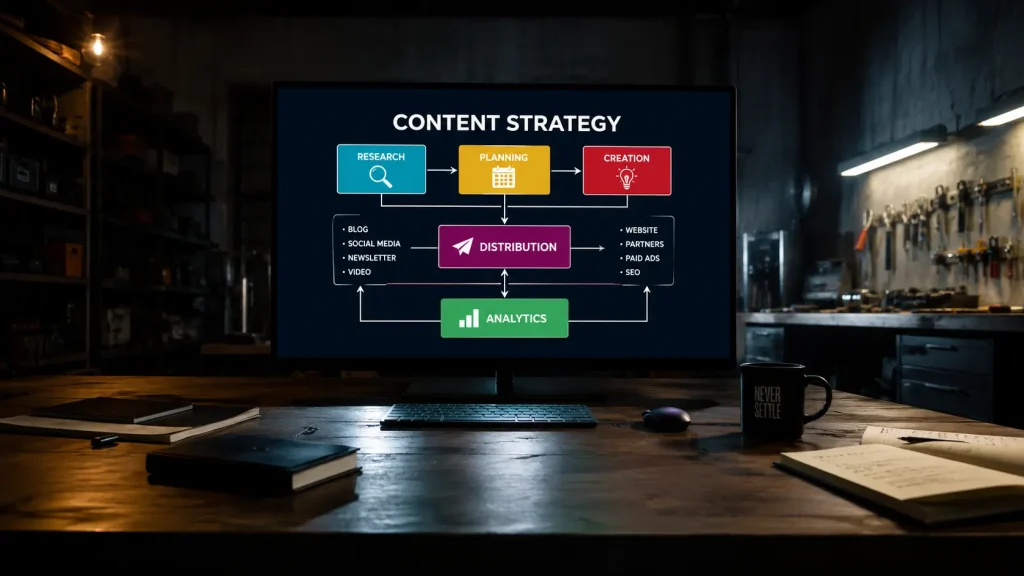
A successful content strategy measures reader trust. It does not simply count published pieces. Readers and search engines judge your actual work. Most teams run their systems at full capacity. They produce content in massive daily volumes. Yet the real business impact remains surprisingly weak. I faced this exact dilemma with an insurance client. We waited for twenty articles before the week ended. We wrote everything at maximum production speed. The legal editor rejected one third of the drafts. A marketing expert wrote about health insurance products. The industry terminology was completely wrong. Forty hours vanished in a single ten-minute call. I sat at my desk at midnight. I opened Notion to build a distribution table. I matched each writer to their exact field. I added an identity verification field. I added a performance evaluation field after every piece. It was not a magic tool. It was simply a clear structure. It separated writers from reviewers. The next project finished in three days. Legal gave zero feedback. We saved twenty-two hours. I rebuilt the strategy on one principle. The right writer in the right place. Clear checks and steady standards build the system in layers.
- Layer One: The Vetted Creator Network in the Content Operating Model
- Layer Two: The Organized Workflow That Protects Quality
- Layer Three: Leveraging AI Within Strict Guardrails
- Layer Four: Governance and Measuring Real Impact
-
Two Hours in the Content War Room Taught Me More Than Ten Years
-
Frequently Asked Questions
- What is the operating model in a content strategy?
- What is the real cost of ignoring an organized operating model?
- How does an organized model with AI compare to smart writing tools alone?
- How can you build a scalable content strategy based on the four-layer model?
- Is this system safe for regulated industries like healthcare and finance?
-
Frequently Asked Questions
- Conclusion
Layer One: The Vetted Creator Network in the Content Operating Model

Anonymous content creates immediate trust issues. Regulated sectors like healthcare and finance face strict compliance risks. A creator who delivers real work deserves a byline. Search engines share this exact view.
Why Anonymous Content Fails to Build Trust
In January 2025, Google updated its search guidelines. The engine ranked pages relying entirely on AI as lowest quality. Search Central documented that mass-producing low-value pages violates spam policies. Anonymous markets and AI platforms hit the same wall. Humans and algorithms demand verified experts. A strong creator network vets every contributor. It matches experts to assignments before review. You never assign a retirement planner to cardiology. The reputational risk is too high. Even strong writers need time to learn new fields. This delays your scaling goals.
How to Verify Expert Identities and Match Topics
The verification process always starts with identity confirmation. The next step involves a thorough portfolio review. You should test subject knowledge when necessary. Finally, you score performance continuously based on editorial results. We refined this process over years at Contently. Our enterprise content operating model proves this method. Precise specialty separation cuts review time in half. This structure supports every following layer. It covers workflow, AI integration, and governance.
Layer Two: The Organized Workflow That Protects Quality

Scaling content suggests forward movement. But which direction are you heading? Too many Google Docs and Slack threads waste time. Project management burdens editors. Quality improvement time becomes a frantic scramble.
The Five Essential Stages with Mandatory Editorial Checkpoints
The solution lies in five stages. Each stage requires mandatory editorial checkpoints. Brief: Define assignments based on real audience needs. Source: Vet experts and verify citations. Draft: Align text with brand voice. Review: Secure legal and brand approvals. Publish: Ensure attribution remains accurate. This sequence prevents blame games. Every error gets traced to its origin.
Building an Audit Trail That Links Actions to Owners
Every action gets timestamped. Every summary, source, edit, and approval links to a team member. Regulated industries rely on this protection. It prevents regulatory disasters. I recall a legal client project. An audit trail saved us from a Friday emergency meeting. We documented every step. We knew exactly who approved each paragraph. This operational side becomes complete when we add digital acceleration. We use it intelligently, not chaotically.
Layer Three: Leveraging AI Within Strict Guardrails

AI is not an autopilot system. It is an accelerator for specific steps. Every AI-assisted step passes a credentialed editor. The principle remains simple. AI content never publishes without real human intervention.
Permitted AI Steps and Strictly Prohibited Actions
AI works best for research synthesis. It builds initial draft structures. It optimizes SEO and metadata. It is strictly forbidden for factual claims. Regulated topics require human verification. The final signature voice must be human. Any output skipping human review is banned. The human editor reviews everything. The audit trail attributes every action. The same voice and compliance standards apply to all. AI platforms that skip verification produce hallucinations. They also cause brand voice drift.
Avoiding Hallucination and Brand Voice Drift
Hearst’s King Features offers a stark example. They distributed a summer supplement to major newspapers. The supplement listed fictional books by real authors. An independent writer used AI. They skipped verification completely. No editorial oversight existed between AI output and publication. The result damaged partnerships with content providers. Programs with excessive guardrails also fail. They produce generic content. The human editor must stay at every checkpoint. This leads directly to the final layer. It ties everything to a single standard.
Layer Four: Governance and Measuring Real Impact
Governance unites the first three layers. It creates a cohesive system. It establishes brand voice rules. It defines compliance checks. It sets review timelines for every piece. Without it, results stay inconsistent.
Success Metrics in the Era of Direct Answers
AI Overviews change how we measure success. Do not measure success by visits alone. Measure share of voice in search results. Measure citation rates in AI answers. Measure publish time per content type. Measure first-attempt review pass rates. Regulated industries must add audit readiness. You must reconstruct any article history in under an hour. Notice what is missing from this list. Raw traffic is a lagging indicator. It is unreliable today.
Applying the Authority-First Content Strategy
I once felt frustrated by shallow practices. We focused on proven lead generation strategies built on trust. We applied an authority-first content operating model. We produced deep guides and case studies. We avoided superficial viral content. We tracked three metrics. Customer acquisition cost, conversion rate, and repeat purchases. The Net Promoter Score improved noticeably. Real authority drives sales.
Two Hours in the Content War Room Taught Me More Than Ten Years
I wasted time on endless revisions. I rebuilt workflow systems after every project. Real change began when I viewed the problem surgically. I stopped acting like a content marketer. I diagnosed four vital organs. Creator, workflow, accelerator, and governance. Every project now passes this anatomy check. Clients complain about volume? I check the creator layer. Clients complain about deadlines? I check the workflow. Clients complain about quality? I check the accelerator. Clients complain about everything? Governance is the broken organ. I developed a weekly habit. Every Monday, I open my dashboard. I review one metric per layer. First-attempt approval rates. Legal review time. Articles bypassing the audit trail. This morning diagnostic saves my team four hours weekly. The system is not an AI tool. It is not an editing platform. It is clarity in roles and standards. It is the courage to reject content. Test this now. Open your current project. Match it against the four layers. How many pieces fail the first layer? Start there.
Frequently Asked Questions
What is the operating model in a content strategy?
Planning decides what to build and why. The operating model is the production system. It defines who creates content. It maps how pieces flow through editorial checkpoints. It shows where AI fits. It measures performance against standards. Both work together for a solid foundation.
What is the real cost of ignoring an organized operating model?
Hidden costs appear in project management chaos. You lose your brand voice. You risk search engine penalties. Quick AI fixes are temporary painkillers. A solid system saves infinite review costs. It prevents regulatory risks.
How does an organized model with AI compare to smart writing tools alone?
AI-only tools cause voice drift and hallucinations. An organized model embeds AI in specific steps. It uses AI for research and structuring. Every output faces strict human review. The same standards apply to all.
How can you build a scalable content strategy based on the four-layer model?
Evaluate your gaps against the four layers. Vetted creator network, structured workflow, AI guardrails, and governance. Document writer identities. Match them to specialties. Set strict AI review rules. Measure authority and citations. Ignore raw traffic alone.
Is this system safe for regulated industries like healthcare and finance?
It is designed specifically for these sectors. It provides an audit trail. It logs every edit and approval. Verified creators ensure accuracy. Governance lets you rebuild history quickly. Content belongs to real experts. They are defensible in compliance reviews.
Conclusion
A trustworthy content system is not purchased. It is built as corporate culture. Layer one requires a human expert. Layer two needs a clear path. Layer three uses bounded AI. Layer four demands strict governance. Which layer is most eroded in your current system?
Discover more from أشكوش ديجيتال
Subscribe to get the latest posts sent to your email.
![إطلاق تحديث AI Overviews لزيادة نقرات موقعك [أهم الأخبار]](https://hcouchd.com/wp-content/uploads/2026/10/file_00000000b58881f5b3423f2d1585d9ee-1024x576.webp)
![ضاعف أرباح إعلانات Google Ads للفروع المتعددة [5 أسرار]](https://hcouchd.com/wp-content/uploads/2026/09/file_0000000060c081f58e0e7cfa4922ea6d-1024x576.webp)