What you are about to read may completely change your perspective on the future of image editing in the design world. Have you ever imagined editing an image simply by writing a single sentence? Or transforming an ordinary photo into a masterpiece without being an expert in complex software? Google’s new AI-powered image editing tools make this possible, but what most Arab designers don’t know is that this technology holds the potential for a radical shift that will revolutionize the industry.
The truth goes deeper than simply simplifying processes. What Google is introducing today in 2025 isn’t just new tools, but a complete approach to redefining visual creativity. The real question is: Are you ready for this transformation?
- A true revolution in the world of design: How is artificial intelligence reshaping standards?
- Google’s advanced technologies: Beyond words to images
- Practical application: From idea to result in minutes
- Challenges and opportunities: A practical look at Arab designers
- Advanced strategies: How do professionals maximize their gains?
- Impact on the job market: What is required of designers today?
- A look at the future: beyond 2025
- Summary: A new era of accessible creativity
A true revolution in the world of design: How is artificial intelligence reshaping standards?
The design industry in 2025 will witness a transformation unlike anything seen since the advent of Photoshop. New AI tools will not only simplify existing tasks but also create entirely new creative possibilities.
What makes this revolution different is the way it tackles the technical barrier that designers have long faced. Previously, mastering programs like Photoshop required years of training and practice. Today, anyone can make complex edits simply by describing what they want.
The statistics speak for themselves : according to recent data for 2025, AI-powered design tools saw a 340% increase in usage in the past year alone. This growth is not a coincidence, but rather a reflection of a fundamental shift in how we think about creativity.
But there’s a bigger secret behind this rising success…
Google’s advanced technologies: Beyond words to images
Google’s new tools rely on deep learning and generative neural network technologies that understand visual context in a way that mimics human understanding. What distinguishes these technologies is their ability to:
• Advanced contextual analysis : Understanding the relationships between elements in an image.
• Intelligent content generation : Adding elements that complement the original image.
• Selective editing : Applying changes to specific parts without affecting the rest of the image.
• Quality preservation : Ensuring that no detail is lost during editing.
The real innovation lies in how these tools handle natural language . You can now ask for “make the sky more dramatic” or “add a reflection of the buildings on the water,” and the system will understand your intention with astonishing accuracy.
But it doesn’t stop there. New AI image editing tools offer far more advanced capabilities than we can imagine.
Practical application: From idea to result in minutes
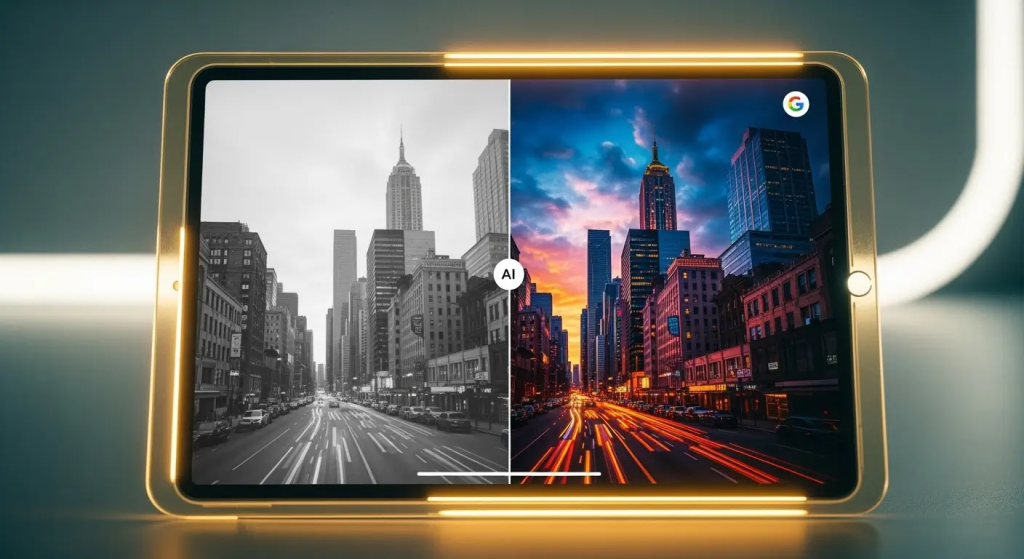
What truly makes smart editing tools revolutionary is their speed and ease of use. In a recent personal experience with my team at a design agency in Riyadh, we were able to complete a full design project for an advertising campaign in half the usual time.
The traditional process required:
- Open Photoshop and upload the image
- Using complex selection tools
- Applying multiple layers of effects
- Manually adjust settings for clocks
- Make frequent adjustments to achieve the desired result.
With the new tools , the process has become:
- Uploading the image to the platform
- Write a brief description of the required modification.
- Get the result in just a few seconds
- Apply additional improvements as needed
The result : Saving 70% of time with similar or better quality than traditional methods.
Before we reveal the secret method professionals use to get the most out of these tools…
Challenges and opportunities: A practical look at Arab designers
Despite its immense potential, the Arab design industry faces particular challenges in adopting these technologies. By observing the local market in 2025, we find a knowledge gap between what is available and what is actually being used.
Key challenges:
Language barrier : Most of these tools operate primarily in English, posing a challenge for designers who prefer to work in Arabic.
Resistance to change : Many seasoned designers are reluctant to give up the tools they have mastered for years.
Intellectual property rights issues : Questions about the ownership of content produced by artificial intelligence.
Golden opportunities:
Democracy of creativity : Making advanced tools available to broader segments of society.
Accelerating production : Completing more projects in less time.
Focus on strategy : Designers should devote themselves to creative thinking rather than technical processes.
And now, the part everyone’s been waiting for…
Advanced strategies: How do professionals maximize their gains?
What no one tells you about artificial intelligence tools is that success in using them depends not only on the technology, but also on understanding the strengths and weaknesses of each tool.
The first strategy : Integration, not replacement.
Smart designers don’t completely abandon traditional tools; instead, they integrate them with intelligent solutions. They use artificial intelligence for initial stages and rapid testing, then move to specialized tools for the final touches.
The second strategy : Mastering the art of command engineering.
Success with these tools requires learning how to formulate commands precisely and in detail. Professionals develop a library of tried and tested commands.
The third strategy : Continuous learning.
The field is evolving at an astonishing rate. What’s new today might be outdated in a few months. Successful designers dedicate time each week to experimenting with new tools.
Impact on the job market: What is required of designers today?

Advances in artificial intelligence technologies are reshaping the job market in the design field. According to a 2025 report by the Dubai Institute of Technology Studies, the skills required for design jobs have undergone a radical transformation.
New skills required :
• Proficiency in using artificial intelligence tools
• Understanding the rules for writing text commands
• Ability to integrate different tools
• Strategic thinking in the use of technology
Skills that have declined in importance :
• Automatic memorization of program shortcuts
• Manual execution of repetitive tasks
• Spending hours on simple technical details
This shift creates golden opportunities for designers who adapt quickly, while others may face challenges in staying ahead.
A look at the future: beyond 2025
What you’re about to learn will shock you… Upcoming developments in AI-powered photo editing will exceed all current expectations. Major tech companies are working on developing:
Interactive augmented reality : Real-time image editing as it’s captured.
Predictive AI : Suggesting edits before the user requests them.
Smart collaboration : Tools that allow teams to collaborate on edits using AI.
By the end of 2025, these technologies are expected to become an integral part of every design project. The question is not whether they will become widespread, but when they will become the standard .
Summary: A new era of accessible creativity
Today we revealed how AI-powered photo editing tools are redefining the concept of visual creativity. From word-based editing to intelligent content generation, we are witnessing a true revolution that is breaking down technical barriers and opening new horizons for Arab creators.
The simple truth is that this development is not merely a technological upgrade, but a civilizational shift in how we approach imagery and creativity. Designers who embrace these technologies today will be tomorrow’s leaders.
The real challenge now is: how will you use this revolution to develop your skills and projects?
We want to hear about your experience! Have you tried any of these tools? What challenges did you encounter? Share your opinion in the comments and tell us about the areas you would like to learn more about in the world of artificial intelligence and design.
Discover more from أشكوش ديجيتال
Subscribe to get the latest posts sent to your email.

![71% من وكلاء الذكاء الاصطناعي مجرد روبوتات محادثة [دراسة]](https://hcouchd.com/wp-content/uploads/2026/09/file_000000008f4081f6b4bb9314f653051e-1024x576.webp)